peptideradar

01 / EMERGING PIPELINE

Retatrutide: The Largest Numbers, and the Shortest Track Record

A triple GIP/GLP-1/glucagon receptor agonist with the biggest weight-loss figures published for any incretin-class compound — and no approval, no Phase 3 results and no long-term outcomes data anywhere.

The short version

Retatrutide, also called LY3437943, is an experimental compound designed to switch on three hormone receptors at the same time: GLP-1, GIP and glucagon. The first two reduce appetite and help control blood sugar. The third raises the amount of energy the body burns. The idea is to work on both sides of the equation at once.

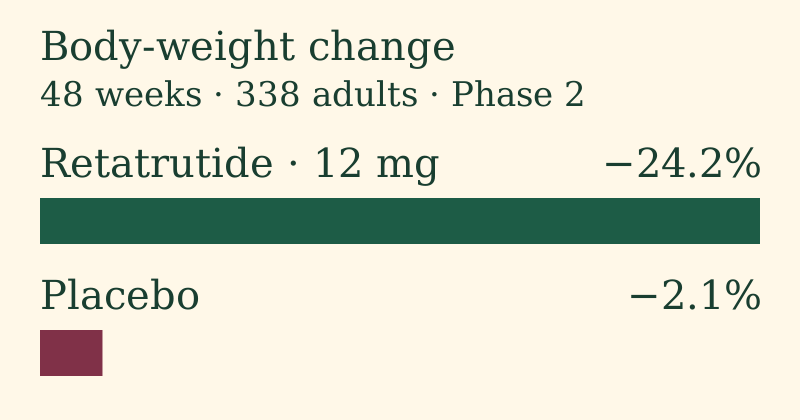
The published results are large. In a 48-week Phase 2 trial in 338 adults with obesity, the highest dose group showed a mean body-weight change of -24.2%, against -2.1% for placebo [4]. In a separate Phase 2 trial in type 2 diabetes, the same dose lowered HbA1c — a three-month average blood-sugar marker — by 2.02 percentage points at 24 weeks [5].

The caveats are equally large. Retatrutide is not approved by any regulator anywhere, Phase 3 trials have not reported, and the trials that would show what happens to hearts, kidneys and body weight over years are still running [1]. Everything below is trial data, not a label.

What it is

Retatrutide is a 39-amino-acid synthetic peptide built on a GIP-based backbone and acylated with a C20 fatty-diacid arm. That fatty arm binds albumin in the blood, which slows clearance enough to make once-weekly subcutaneous administration workable in trials; its molecular formula as the free acid is C221H342N46O68. A first-in-human Phase 1b study in 72 adults with type 2 diabetes measured a half-life of approximately six days, which is the pharmacokinetic basis for the weekly schedule used throughout the later programme [6].

It is a triple agonist — one molecule engaging three separate receptors. Cryo-electron microscopy published in 2024 resolved all three receptor complexes at 2.68, 3.26 and 2.84 Å, and reported that retatrutide is roughly 8.9-fold more potent than native GIP at the GIP receptor, but only 0.3-fold and 0.4-fold as potent as the endogenous hormones at the glucagon and GLP-1 receptors respectively [2]. The same work found the extracellular loop 1 region adopts a rigid alpha-helix at GLP-1R and GCGR but a flexible loop at GIPR. The molecule was evidently engineered to hit three targets unevenly rather than equally, and that asymmetry is a design feature, not an accident.

Development is run by Eli Lilly. As of 2026 the compound sits in Phase 3 and holds no approval, no approved indication and no approved formulation [1].

What it is

How it works — the proposed mechanism

The GLP-1 and GIP arms carry the pharmacology already familiar from the incretin class: appetite suppression and glucose-dependent insulin secretion. The third arm is what makes retatrutide structurally distinct. Glucagon receptor activation — normally associated with releasing stored glucose from the liver — is proposed here to add energy expenditure and lipid mobilisation, so that intake falls while expenditure rises. A 2025 review synthesising the Phase 1 and Phase 2 record characterises the resulting weight-loss magnitude, up to roughly 24% at 12 mg over 48 weeks, as a step-change over prior incretin therapies [1].

The mechanistic story is coherent, and it is worth being precise about what supports it. The receptor engagement itself is directly demonstrated by structural work [2]. The weight and glycaemic outcomes are directly measured in randomised trials [4][5]. The attribution of the extra weight loss specifically to glucagon-driven thermogenesis is an inference drawn across those datasets rather than an isolated measurement, and a post-hoc metabolomic analysis of two Phase 2 trials found that changes in a fatty-acid-oxidation cluster mediated 23.2% of the weight-reduction response in participants without type 2 diabetes [7]. That is supportive and partial — it accounts for roughly a quarter of the effect, not all of it.

What the research actually shows

Phase 2, obesity. The largest published trial randomised 338 adults with obesity (51.8% men, BMI of 30 or above, or 27 to under 30 with a weight-related comorbidity). At 48 weeks, mean body-weight change was -24.2% in the 12 mg once-weekly group versus -2.1% with placebo. Gastrointestinal adverse events were dose-related and mostly mild to moderate, and a dose-dependent heart-rate increase peaked at around 24 weeks [4].

Phase 2, type 2 diabetes. A 36-week trial in 281 adults with type 2 diabetes reported an HbA1c reduction of 2.02 percentage points at 24 weeks in the 12 mg group against 0.01 points on placebo, and a body-weight reduction of 16.94% at 36 weeks versus 3.00% on placebo. Mild-to-moderate gastrointestinal adverse events occurred in 35% of participants; the trial recorded no severe hypoglycaemia and no deaths [5].

Phase 2a, metabolic liver disease. A 48-week substudy in 98 participants with obesity and metabolic dysfunction-associated steatotic liver disease (at least 10% liver fat by MRI-PDFF, without type 2 diabetes) reported relative liver-fat reductions at 24 weeks of -42.9%, -57.0%, -81.4% and -82.4% across the 1, 4, 8 and 12 mg groups against +0.3% on placebo, with 86% of the 12 mg group reaching normal liver fat below 5%, and reductions sustained to 48 weeks [3].

Phase 1b. The first-in-human multiple-ascending-dose study in 72 adults with type 2 diabetes established the approximately six-day half-life and reported a placebo-adjusted weight change of -8.96 kg (90% CI -11.16 to -6.75) at the highest dose over 12 weeks, with treatment-emergent adverse events in 63% of participants, mostly gastrointestinal [6].

Post-hoc biochemistry. Metabolomic and lipidomic analysis across two Phase 2 randomised trials (n=282 with obesity; n=213 with type 2 diabetes) found that higher doses reduced triglycerides — particularly those enriched in short-chain and saturated acyl side chains — and moved insulin-resistance biomarkers including branched-chain amino acids, 2-hydroxybutyrate and urate in a direction associated with lower cardiovascular risk [7]. Post-hoc analyses generate hypotheses; they do not test them.

What is absent from this list is the tier that matters most for a chronic-use compound: no completed Phase 3 trial, no cardiovascular outcomes result, no kidney outcomes result, and no published data on what happens to weight after the compound is stopped [1].

Reported effects, cautions and safety

What follows in this first block is anecdotal, not clinical evidence — self-reports gathered from research-use communities, carrying no verified identity of the material used, no confirmed quantities and no clinical oversight. It is recorded here because it is a real signal about what unmonitored use looks like, not because it is proof of anything.

Frequently described benefits include a near-total silencing of intrusive food thoughts — what community members call food noise going quiet, reported as a disinterest in eating rather than a feeling of fullness — and weight reduction that reporters describe as qualitatively faster than their experience with other incretin-class compounds. Commonly described is a sensation of running warm or flushing, which community discussion attributes to the glucagon arm. Occasionally described are a lift in mood and reduced anxiety around food.

On the adverse side, the same communities frequently describe nausea peaking several hours after administration and worst during early weeks or after stepping up; commonly described are sulfur-smelling burps, constipation, an early-phase dip in energy, and awareness of a faster resting pulse. Occasionally described are transient injection-site itching, disrupted sleep, and a concern that rapid loss feels soft — a worry about muscle going along with fat. Each maps onto something documented in the trials, which is the most that can be said for it.

The cautions grounded in the literature are these:

  • It is unapproved, and gray-market material is unverifiable. Retatrutide remains in Phase 3 and is approved by no regulator [1]. Vials sold through research channels cannot be confirmed to contain authentic compound at the stated concentration; independent analyses of comparable gray-market peptides have found truncated sequences, racemised amino acids and entirely different substances. Without sterility and endotoxin testing, injection carries contamination risk including sepsis, and US regulators have issued warning letters to sellers citing federal food-and-drug law violations.
  • Gastrointestinal effects are dose-dependent and were the main reason people stopped. In the Phase 2 obesity trial nausea affected up to 45% of participants at the highest dose and drove an 18% discontinuation rate at that dose level [4]. Unsupervised escalation removes the one mitigation the trials used.
  • Heart rate rises with dose. Phase 2 data show mean increases of roughly 5 to 7 bpm at the highest doses, peaking near 24 weeks [4]. A dedicated cardiovascular outcomes trial is ongoing and has not reported; arrhythmia burden and cardiac remodelling over years are unknown [1].
  • Interaction with insulin and sulfonylureas is a hypoglycaemia risk. Because the GLP-1 and GIP arms augment insulin secretion, adding them to already-elevated insulin can drive glucose below safe thresholds; Phase 2 participants on background insulin required insulin de-escalation during the trial [5][6].
  • Lean mass falls too. Body-composition work in the programme shows absolute lean-mass loss alongside fat loss. The ratio compares favourably with historic benchmarks, but the absolute loss is meaningful in rapid-loss contexts, particularly for older individuals.
  • Durability and long-term safety are unknown. The pivotal outcome trials, including a dedicated kidney-outcomes study, are ongoing as of mid-2026. Evidence from related incretin agents points to substantial weight regain after discontinuation, so open-ended use sits on an uncharacterised risk curve [1].

No dose is recommended anywhere on this site. Quantities named above are the amounts administered to participants under clinical supervision in the cited trials.

Where it sits on the radar

Retatrutide is the only compound on this desk with randomised human evidence, and it is therefore the only one where the appropriate skepticism is about durability and long-term safety rather than about whether the compound does anything at all. The Phase 2 effect sizes are real, replicated across two indications, and measured against placebo [4][5].

The open questions are the ones that decide whether a compound becomes a medicine: does the effect hold in Phase 3 populations, does it survive discontinuation, and does the heart-rate signal matter over years rather than weeks [1]. Those answers do not exist yet. A compound can produce the largest weight-loss figures in its class and still fail on an outcome nobody has measured — that is not a cynical position, it is the ordinary history of drug development.

Compared with MOTS-c and KPV, retatrutide is several tiers further along and correspondingly better documented, including in its harms. The comparison page sets the three side by side.