02 / EMERGING PIPELINE
MOTS-c: A Peptide Written Inside the Mitochondrion
Sixteen amino acids encoded in mitochondrial DNA, with a well-characterised mechanism, striking results in aged mice, and no interventional human trial anywhere in the published record.
The short version
MOTS-c is a short peptide — 16 amino acids — with an unusual origin. Most peptides in the body are coded by DNA in the cell nucleus. MOTS-c is coded inside the mitochondria, the compartments that turn food into usable energy, within a gene normally read as part of the mitochondrial ribosome.
Its main documented action is switching on AMPK, an enzyme that acts roughly as a low-fuel sensor: when AMPK is active, cells shift toward burning fuel rather than storing it. MOTS-c does this indirectly, by interfering with a step in the folate cycle so that a signalling molecule called AICAR accumulates [10]. Muscle appears to be the main target tissue.
The interesting part is that exercise itself raises the body's own MOTS-c levels, and giving extra MOTS-c improved running capacity in mice — including old ones [11]. The unavoidable part is that essentially all of that work is in cells and rodents. There is no published trial in which people were given MOTS-c and measured against a control group. Every human-performance and anti-ageing claim made for it is an extrapolation.
What it is
MOTS-c stands for mitochondrial open reading frame of the 12S rRNA type-c. Its sequence is MRWQEMGYIFYPRKLR, and it is encoded within the MT-RNR1 gene of the mitochondrial genome — a stretch of DNA whose primary job is to produce a ribosomal RNA, not a peptide. The sequence is highly conserved across mammals, which is generally taken as evidence that it does something worth conserving.
It belongs to a small family known as mitochondrial-derived peptides, and its discovery reframed the mitochondrion as a signalling organelle rather than purely a power plant. A 2023 review in the Journal of Translational Medicine consolidates the biology: the encoding within MT-RNR1, the AMPK and folate-cycle mechanism, the nuclear translocation, the exercise inducibility, and the spread of proposed roles across metabolic, stress-adaptive and ageing pathways [10]. That review is the orientation reference for the field, and it is a review — a synthesis of what other groups have reported, not new evidence.
Regulatory status is unambiguous. MOTS-c is not approved by the FDA for any human use, has no approved formulation or dosing, and is sold only as a research chemical for laboratory work. Anti-doping bodies treat it as a prohibited peptide in elite sport under hormone-and-metabolic-modulator categories, and athletes face sanctions for use.

How it works — the proposed mechanism
The best-characterised action is inhibition of the folate cycle and de novo purine biosynthesis. Blocking that pathway causes AICAR to build up, and AICAR activates AMP-activated protein kinase. Downstream, AMPK activation is associated with improved glucose handling and insulin sensitivity, primarily in skeletal muscle [10].
A second, more unusual behaviour is retrograde signalling. Under metabolic stress, MOTS-c moves out of the mitochondrion and into the nucleus, where it regulates nuclear gene expression in an AMPK-dependent manner — including antioxidant-response-element genes through interaction with the stress-responsive transcription factor NRF2. Work in human and mouse cell lines demonstrated this translocation and described it as the first retrograde signalling shown for a mitochondrially encoded peptide [12]. Put plainly: a peptide written in mitochondrial DNA travels to the nucleus and changes which nuclear genes are read.
A third strand identifies a direct molecular partner. A 2024 study reported that MOTS-c binds and activates casein kinase 2 in cell-free systems, and that tissue-specific modulation of CK2 — activation in muscle, suppression in fat — underlies its effects on muscle glucose uptake and on preventing muscle wasting [8]. This is the most mechanistically specific result in the MOTS-c literature, and it is a single-group finding awaiting independent replication.
What the research actually shows
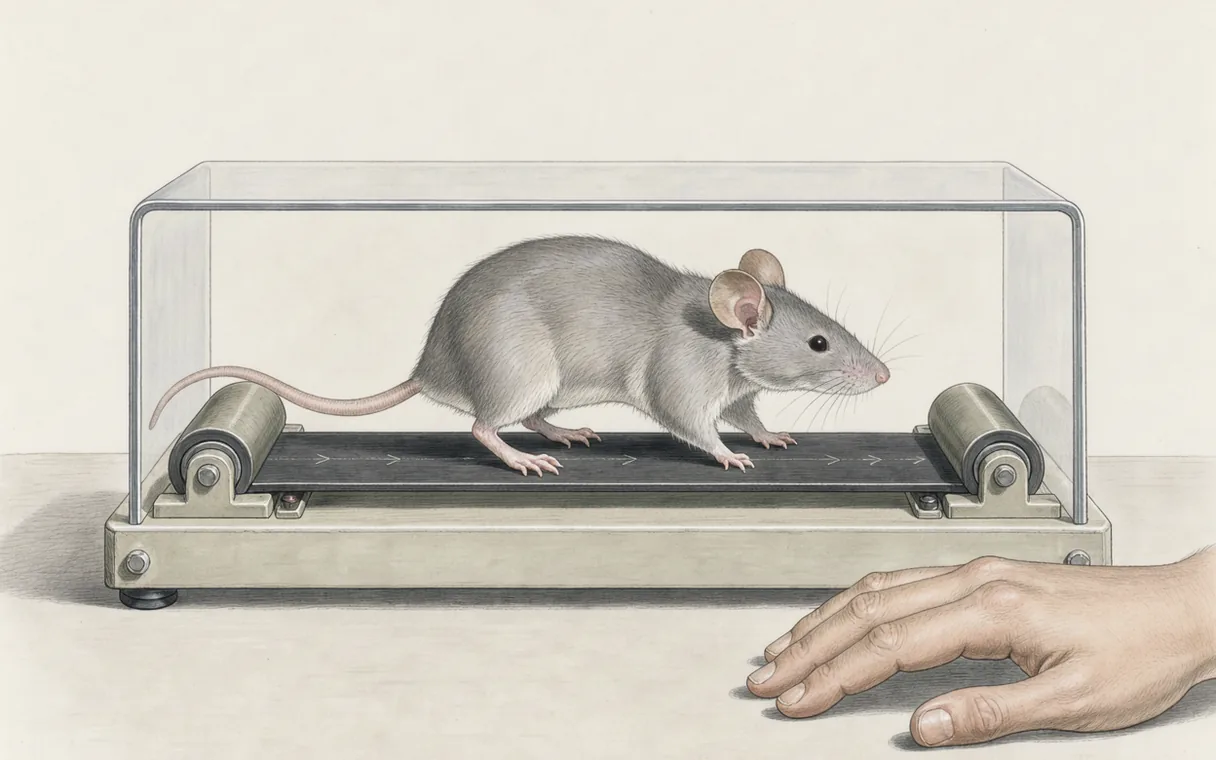
Exercise mimetic, in mice. The most-cited functional result comes from a 2021 study in Nature Communications. Exercise induced endogenous MOTS-c expression in skeletal muscle and in circulation, and administering exogenous MOTS-c significantly enhanced physical performance in young, middle-aged and old mice (2, 12 and 22 months). In aged animals of 22 to 23.5 months, treadmill running capacity increased with a reported p-value of 0.000002, alongside improvements in grip strength and gait [11]. It is a clean, well-powered rodent result — and it is a rodent result.
Direct target identification. The 2024 CK2 study used young, aged, high-fat-diet and immobilised mice together with cell-free assays, and demonstrated prevention of skeletal muscle atrophy and enhanced muscle glucose uptake through tissue-specific CK2 modulation [8].
Retrograde nuclear signalling. Stress-induced nuclear translocation and AMPK-dependent regulation of antioxidant and metabolic genes were shown in HEK293 cells and fibroblasts [12]. Mechanism, at the cellular tier.
The human data, and what they are not. The strongest human clinical-association evidence is a prospective multicentre cohort of 94 chronic haemodialysis patients followed for a median of 26.5 months. Circulating MOTS-c was independently associated with a composite of all-cause mortality and non-fatal cardiovascular events, with a Cox hazard ratio of 1.004 and a p-value of 0.05; adding MOTS-c to the risk model improved discrimination, moving the ROC area under the curve from 0.727 to 0.743 [9].
That study deserves reading carefully rather than quoting triumphantly. It measures the peptide people already have circulating, not a peptide administered to them. The hazard ratio sits barely above 1 and the p-value sits exactly on the conventional threshold. And the direction of the association means higher circulating MOTS-c tracked with more adverse events in this population — which does not fit neatly into a simple protective narrative, whatever the underlying biology turns out to be. It is a biomarker signal in a small, unusual cohort, and it is the best human evidence this compound has.
Cautions, gaps and what is missing
This digest records no community-report layer for MOTS-c and no corpus-level safety-caution set, because neither exists in a form worth reproducing. That absence is itself the headline: an adverse-effect profile cannot be described as favourable when no controlled human trial has ever looked for one.
The documented limitations, stated plainly:
- No human efficacy trials. Every claim that exogenous MOTS-c improves metabolism, performance or ageing comes from cell or animal work, predominantly mice and rats [8][11][12]. The human data are observational biomarker associations, not interventional outcomes [9].
- No validated human pharmacokinetics. There is no published, measured human half-life, bioavailability or dose-response relationship. Rodent dosing regimens cannot be extrapolated to people, and any figure circulating online as a human protocol has no measured basis.
- Research-chemical status. MOTS-c is not approved by the FDA for any use and is sold only for laboratory research. Purity, identity and sterility vary by supplier and are not regulated to pharmaceutical standards.
- Prohibited in elite sport. Anti-doping authorities treat MOTS-c as a prohibited peptide under hormone-and-metabolic-modulator categories; use carries sanctions for tested athletes.
- Single-lab reliance. Several key findings, including the CK2 target identification, come from one group and await independent replication [8]. Some human biomarker studies are small or preliminary [9].
- Population differences are documented. A pro-diabetogenic mitochondrial DNA variant affecting MOTS-c (m.1382A>C) and ancestry-dependent exercise responses both suggest effects are not uniform across populations — an inconvenient fact for any universal claim.
- Consumer demand outruns the evidence. Search interest in MOTS-c for fat loss, longevity and performance vastly exceeds the strength of the underlying clinical record. That gap is the reason this page exists.
No human dose is recommended here. This site names quantities only as they were administered in cited studies, and for MOTS-c no such human study exists to name.
Where it sits on the radar
MOTS-c is the clearest example on this desk of a compound whose mechanism is far better established than its effects. The molecular biology is genuinely well worked out — the encoding, the AMPK route, the nuclear translocation, a candidate direct target [8][10][12]. The functional evidence is confined to animals [11], and the human record is a single small observational cohort pointing in an awkward direction [9].
That combination is exactly where overclaiming happens. A mechanism that is easy to explain, a mouse result with a striking p-value, and an absence of human trials leaves plenty of room to fill. The correct reading is that MOTS-c is a legitimate and interesting research target that has not been tested as a therapy in people.
Compared with retatrutide, which has randomised human trials, MOTS-c is two tiers back. Compared with KPV, it is marginally ahead — it has at least been measured in a human cohort. The comparison page sets the three out together.